


Import Advice
Targeted advice specifically for your business to navigate the complexities of international trade, empowering you to make sourcing and manufacturing decisions with confidence.
Dedicated training/group sessions to help you better understand the basics of international trade, how to navigate customs regulations, mitigate trade risks, and reduce cost.

Customs Clearance
Providing Customs Release Operating Procedures, to ensure your company avoids delays at the border.
Preparing and submitting customs declarations on your behalf.

CBSA Financial Security
Need CBSA Financial Security?
Release Prior to Payment Import Bond (RPP)
Non-Resident Importer GST Bond
Temporary Importation Bond
Bonded Carrier
Bonded Freight Forwarder
Carnet Bond
Customs Bonded Sufferance Warehouse
Need Import Advice?

Let us help & improve your customs experience!
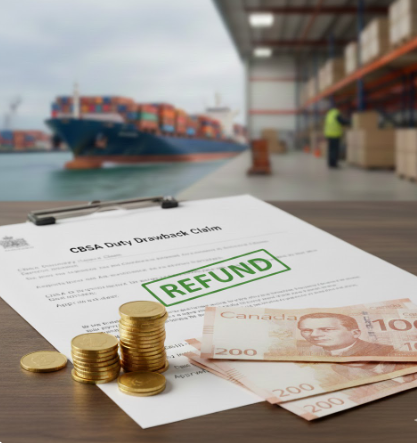
Duty Drawback
Unlock Hidden Cash: Recover Your Customs Duties with the CBSA Duty Drawback Program
Don't leave money on the table. We specialize in maximizing your duty refunds on imported goods that were not consumed in Canada.
CUSMA Certification & Compliance Consulting
Don't let CUSMA compliance risk threaten your U.S. and Mexican market access. As a Canadian exporter, the Certification of Origin is your responsibility.
Our consulting service provides the expert guidance, audit-ready documentation, and clear Rules of Origin analysis you need to confidently sign off on CUSMA.
Stop guessing and start shipping with certainty.

CBSA’s New Importer Payment Portal (CARM)
Are you Ready? If not, BORDER DELAYS!
Deadline May 20th, 2025
Starting May 20th, 2025, your broker will only handle the initial customs declaration.
You, the importer, will be directly responsible for all payments to the CBSA in the CARM client portal – customs brokers can no longer pay on your behalf.
To avoid your shipments being stopped:
Register in the CBSA CARM portal
Delegate access to your customs broker
Enroll in the Release Prior to Payment (RPP) program Buy a Bond Today!
Provide your own financial security
We suggest using our trade advisory services to help you navigate CARM and ensure a smooth transition for your supply chain.
-
You can access the CARM Client Portal (CCP) from the CBSA website: https://ccp-pcc.cbsa-asfc.cloud-nuage.canada.ca/en/homepage
To register, you need your Business Number (BN9) plus Importer Program Number (RM). This 15-character BN15 is structured as follows:
Example BN15: 123456789RM0001
The BN9 is the unique business number assigned by the Canada Revenue Agency (CRA).
The RM number identifies the CBSA program associated with the business.
🔹 For Canadian-based businesses: Most already have a BN9. If not, they can obtain one during CCP registration.
🔹 For Non-Resident Importers (NRIs): They must get a BN9 from CRA before registering on the CCP.💡 RM Program Number Details:
The CBSA program number (RM) defines the type of user and their activities on the portal.
Importers, brokers, warehouses, and sureties each have distinct RM numbers.
Carriers and Warehouses must obtain a unique RM Program Number specific to their activities. Additionally, Carriers and Warehouses must request CBSA link their Carrier Code with their BN9 before any financial security may be filed. This request may be submitted using the CBSA Client Support Contact webform.
RM numbers are assigned sequentially (e.g., RM0001, RM0002, etc.).
-
The RPP program allows importers to have their goods released by the Canada Border Services Agency (CBSA) before they pay duties and taxes. However, importers must now provide their own financial security to participate in RPP, as they can no longer rely on their customs broker’s financial security.
Without RPP, importers must pay all duties and taxes at the time of importation before their goods are released.
-
If you do not provide the required financial security by the deadline, you will no longer be eligible for RPP. This means you must pay duties and taxes at the time of importation before CBSA releases your goods.
-
CBSA calculates your required financial security based on your highest monthly accounts receivable balance (including duties and GST) over the last 12 months for each of your program accounts (RM accounts).
This required amount will be visible in your CARM Client Portal.
-
There are two ways to provide financial security:
Written Security Agreement (a financial institution such as a bank or surety bond provider) *Buy a Bond Today!
Must be at least 50% of the required financial security (minimum CAD $5,000 per RM account).
One option for financial security is an RPP bond, which can be arranged through your customs broker. Many brokers collaborate with surety providers, to help importers facilitate the process.
You must first contact a financial security provider to set up an agreement before entering the details in the CARM Client Portal.
Security Deposit (made directly in the CARM Client Portal)
Must be 100% of the required financial security.
There is no minimum deposit requirement.
-
If your company imports goods commercially into Canada, there are no exceptions or opt-out possibilities. All importers of commercial goods will be required to set up a CCP account for their business.
-
The person initially registering your business on the CARM Client Portal (CCP) – the Business Account Manager (BAM) – should be someone who knows your business details registered with the Canada Revenue Agency (CRA) and ideally has some involvement in your company's financial management.
While the CBSA doesn't specify who can register, the person who does automatically becomes the BAM. The BAM has full control over the company's CCP account and is responsible for approving access for other employees, including secondary BAMs and Program Account Managers (PAMs).description
-
Consider granting CCP access to employees involved in various import-related activities, such as managing broker relationships, ensuring customs compliance, handling post-entry adjustments, overseeing duty deferral programs, managing ruling requests, paying broker fees and CBSA duties, purchasing imported goods, and managing receiving activities.
-
Most importantly, you must delegate authority to your customs broker through the CARM Client Portal (CCP) for them to be able to submit Commercial Accounting Declarations (CADs) to the CBSA on your behalf. Without this CCP delegation, even with a power of attorney, your broker will be unable to finalize and account for your customs entries.
-
CBSA’s New Importer Payment Portal (CARM)
Are you Ready? If not, BORDER DELAYS!
Deadline May 20th, 2025
Starting May 20th, 2025, your broker will only handle the initial customs declaration.
You, the importer, will be directly responsible for all payments to the CBSA in the CARM client portal – customs brokers can no longer pay on your behalf.
To avoid your shipments being stopped:
Register in the CBSA CARM portal
Delegate access to your customs broker
Enroll in the Release Prior to Payment (RPP) program Buy a Bond Today!
Provide your own financial security
We suggest using our trade advisory services to help you navigate CARM and ensure a smooth transition for your supply chain.
-
You can access the CARM Client Portal (CCP) from the CBSA website: https://ccp-pcc.cbsa-asfc.cloud-nuage.canada.ca/en/homepage
To register, you need your Business Number (BN9) plus Importer Program Number (RM). This 15-character BN15 is structured as follows:
Example BN15: 123456789RM0001
The BN9 is the unique business number assigned by the Canada Revenue Agency (CRA).
The RM number identifies the CBSA program associated with the business.
🔹 For Canadian-based businesses: Most already have a BN9. If not, they can obtain one during CCP registration.
🔹 For Non-Resident Importers (NRIs): They must get a BN9 from CRA before registering on the CCP.💡 RM Program Number Details:
The CBSA program number (RM) defines the type of user and their activities on the portal.
Importers, brokers, warehouses, and sureties each have distinct RM numbers.
Carriers and Warehouses must obtain a unique RM Program Number specific to their activities. Additionally, Carriers and Warehouses must request CBSA link their Carrier Code with their BN9 before any financial security may be filed. This request may be submitted using the CBSA Client Support Contact webform.
RM numbers are assigned sequentially (e.g., RM0001, RM0002, etc.).
-
The RPP program allows importers to have their goods released by the Canada Border Services Agency (CBSA) before they pay duties and taxes. However, importers must now provide their own financial security to participate in RPP, as they can no longer rely on their customs broker’s financial security.
Without RPP, importers must pay all duties and taxes at the time of importation before their goods are released.
-
If you do not provide the required financial security by the deadline, you will no longer be eligible for RPP. This means you must pay duties and taxes at the time of importation before CBSA releases your goods.
-
CBSA calculates your required financial security based on your highest monthly accounts receivable balance (including duties and GST) over the last 12 months for each of your program accounts (RM accounts).
This required amount will be visible in your CARM Client Portal.
-
There are two ways to provide financial security:
Written Security Agreement (a financial institution such as a bank or surety bond provider) *Buy a Bond Today!
Must be at least 50% of the required financial security (minimum CAD $5,000 per RM account).
One option for financial security is an RPP bond, which can be arranged through your customs broker. Many brokers collaborate with surety providers, to help importers facilitate the process.
You must first contact a financial security provider to set up an agreement before entering the details in the CARM Client Portal.
Security Deposit (made directly in the CARM Client Portal)
Must be 100% of the required financial security.
There is no minimum deposit requirement.
-
If your company imports goods commercially into Canada, there are no exceptions or opt-out possibilities. All importers of commercial goods will be required to set up a CCP account for their business.
-
The person initially registering your business on the CARM Client Portal (CCP) – the Business Account Manager (BAM) – should be someone who knows your business details registered with the Canada Revenue Agency (CRA) and ideally has some involvement in your company's financial management.
While the CBSA doesn't specify who can register, the person who does automatically becomes the BAM. The BAM has full control over the company's CCP account and is responsible for approving access for other employees, including secondary BAMs and Program Account Managers (PAMs).description
-
Consider granting CCP access to employees involved in various import-related activities, such as managing broker relationships, ensuring customs compliance, handling post-entry adjustments, overseeing duty deferral programs, managing ruling requests, paying broker fees and CBSA duties, purchasing imported goods, and managing receiving activities.
-
Most importantly, you must delegate authority to your customs broker through the CARM Client Portal (CCP) for them to be able to submit Commercial Accounting Declarations (CADs) to the CBSA on your behalf. Without this CCP delegation, even with a power of attorney, your broker will be unable to finalize and account for your customs entries.
-